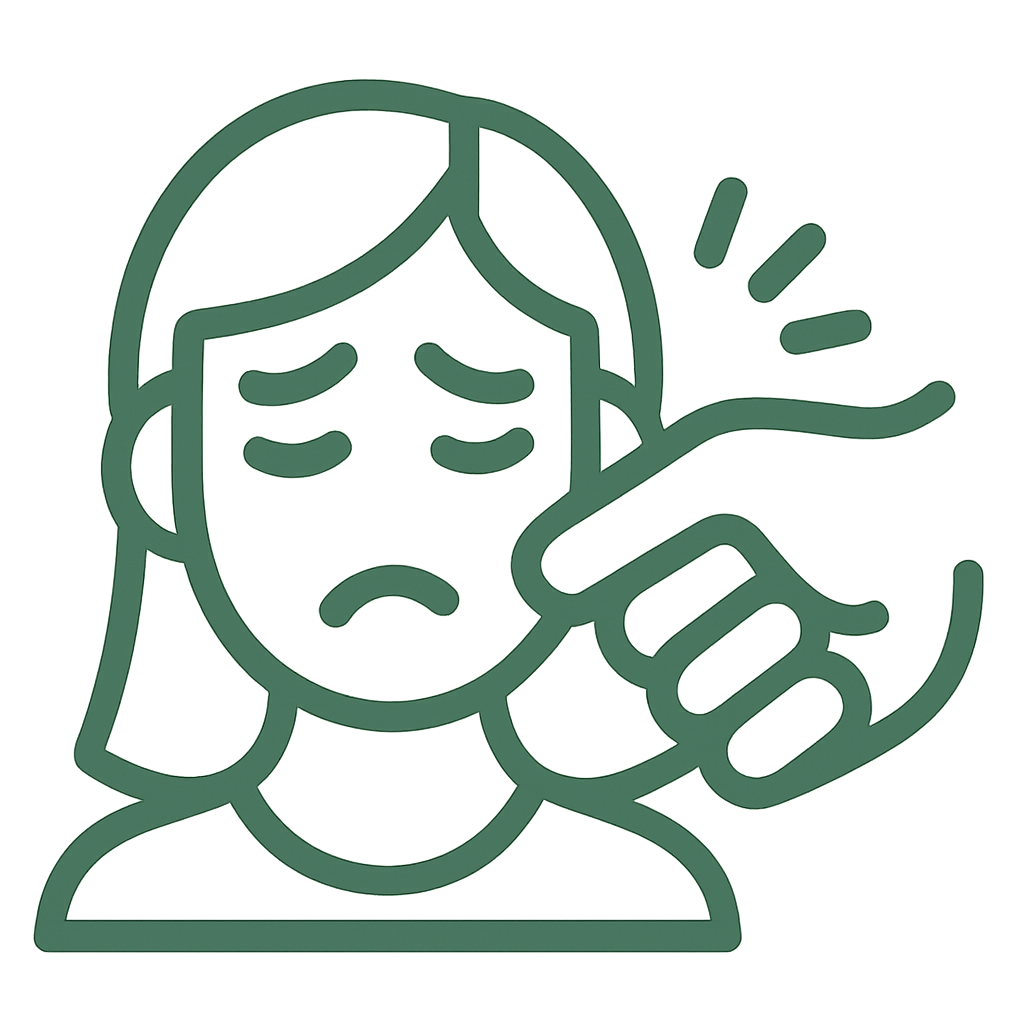
Understanding facial tightness
The face is one of the most muscularly busy parts of the body — dozens of small muscles that express, chew, squint, and frown all day long. Under stress, many of us recruit them without noticing: the jaw clamps at a difficult email, the brow knits during concentration, and at night the clenching continues as grinding. Because these muscles are small and never far from bone, chronic tension shows up quickly as aching temples, a sore jaw joint, tired eyes, and that unmistakable drawn, held feeling. Left alone, the pattern feeds tension headaches and can strain the jaw joint itself.
How our therapies help
Our approach is precise and deeply calming. Shiatsu applies slow fingertip pressure to the specific muscles that hold facial tension — the masseter at the jaw, the temporalis at the temples, the muscles of the brow and scalp — releasing each point and re-teaching the face what relaxed actually feels like. Reflexology works from the other direction, using pressure points on the feet and hands connected with the head and face to settle the whole nervous system, since a calm system is far less likely to clench in the first place.
A softer, more rested face
Clients usually notice the change in the mirror before anyone tells them: a smoother brow, an unclenched jaw, a face that looks as rested as it feels. With a short course of sessions and a few daily habits — the jaw check, the warm evening compress — the released state becomes your face's new default.
Questions we are asked
How many sessions will I need?+−
Facial tension usually releases quickly — four to six sessions is a typical course. If clenching is a long-standing habit, occasional top-up sessions help keep it from creeping back.
What does facial shiatsu feel like?+−
Slow, precise fingertip pressure over the jaw, cheeks, brow, and scalp, matched with reflex point work on the feet and hands. Most clients find it remarkably deep and relaxing — falling asleep is common.
Will this help with my tension headaches too?+−
Often, yes. The muscles that tighten the face — jaw, temples, brow — are frequent contributors to tension-type headaches, so releasing them tends to ease both together.
When should I see a doctor or dentist?+−
If your jaw locks or clicks painfully, if you notice facial numbness, drooping, or sudden asymmetry, or if grinding is damaging your teeth, see a dentist or doctor. Sudden facial weakness needs emergency care.